• Home
    Home
  • Main Portfolio
    Main Portfolio
  • MIFGS 2023
    MIFGS 2023
  • MIFGS 2024
    MIFGS 2024
  • About Us
    About Us
  • Our Process
    Our Process
  • Services
    Services
    • Custom Design
      Custom Design
      • Feng Shui Garden Design
        Feng Shui Garden Design
    • Design Implementation
      Design Implementation
    • Construction & Maintenance
      Construction & Maintenance
    • DIY – DesignedBliss4U
      DIY – DesignedBliss4U
    • Other Services
      Other Services
      • Staging for sale
        Staging for sale
      • Productive gardens
        Productive gardens
      • Rejuvenation projects
        Rejuvenation projects
  • Design Fees & Packages
    Design Fees & Packages
  • Media Publications
    Media Publications
  • Design Resources
    Design Resources
    • FAQs
      FAQs
    • Why use a designer?
      Why use a designer?
    • Ebooks & Videos
      Ebooks & Videos
    • Blog
      Blog
    • Before & After – Glen Waverley Garden Design
      Before & After – Glen Waverley Garden Design
    • Before & After – Blackburn Garden Design
      Before & After – Blackburn Garden Design
    • Before & After – Hawthorn Garden Design
      Before & After – Hawthorn Garden Design
    • Case study – Water Features
      Case study – Water Features
    • Case Study – Productive Garden Design
      Case Study – Productive Garden Design
    • Case study – Vertical Gardens
      Case study – Vertical Gardens
    • Case Study – Vegetable patches
      Case Study – Vegetable patches
    • Case Study – Soil testing
      Case Study – Soil testing
  • Contact Us
    Contact Us
  • Home
    Home
  • Main Portfolio
    Main Portfolio
  • MIFGS 2023
    MIFGS 2023
  • MIFGS 2024
    MIFGS 2024
  • About Us
    About Us
  • Our Process
    Our Process
  • Services
    Services
    • Custom Design
      Custom Design
      • Feng Shui Garden Design
        Feng Shui Garden Design
    • Design Implementation
      Design Implementation
    • Construction & Maintenance
      Construction & Maintenance
    • DIY – DesignedBliss4U
      DIY – DesignedBliss4U
    • Other Services
      Other Services
      • Staging for sale
        Staging for sale
      • Productive gardens
        Productive gardens
      • Rejuvenation projects
        Rejuvenation projects
  • Design Fees & Packages
    Design Fees & Packages
  • Media Publications
    Media Publications
  • Design Resources
    Design Resources
    • FAQs
      FAQs
    • Why use a designer?
      Why use a designer?
    • Ebooks & Videos
      Ebooks & Videos
    • Blog
      Blog
    • Before & After – Glen Waverley Garden Design
      Before & After – Glen Waverley Garden Design
    • Before & After – Blackburn Garden Design
      Before & After – Blackburn Garden Design
    • Before & After – Hawthorn Garden Design
      Before & After – Hawthorn Garden Design
    • Case study – Water Features
      Case study – Water Features
    • Case Study – Productive Garden Design
      Case Study – Productive Garden Design
    • Case study – Vertical Gardens
      Case study – Vertical Gardens
    • Case Study – Vegetable patches
      Case Study – Vegetable patches
    • Case Study – Soil testing
      Case Study – Soil testing
  • Contact Us
    Contact Us
Productive vegetable patch in metal planters in Kew garden design

What to Plant in Spring, a Planting Guide

October 22, 2019
-
Landscape Design, Productive gardens, Seasonal tips, Sustainable Gardening
-
Posted by Parveen

The most important thing to do in spring for your productive garden is planting. It is a task that will pay off big dividends!

So forget all those other spring tasks you’ve got on your plate at the moment and get planting before it’s too late!

I know it’s hard to get organised.  I have young kids and a busy work schedule but I do love the taste of home grown produce.  Nothing like it! Yums!  Yes, food motivates me. A Lot! 🙂

So to help you kickstart your garden, we created a planting guide.

Let’s get planting to give your seedlings enough time to grow and bear you their wonders before it’s too late!  It’s a good family activity to do during the long weekend coming up, in my view!

Herbs suitable for Melbourne spring (cool climate)

It’s  definitely a long list of alternatives and after trying for a while, you’ll know what suits you and your garden best!

Personally I’ve grown perennial basil, coriander, chives, mint, oregano, parsley, thyme, sage, curry leaf and rosemary in my vege patch.

With mints, I’ve found that the Vietnamese and common mint suit my family’s needs the best.  I’ve tried more unusual varieties like the choc mint but found it too strong for our style of cuisine.  It has a lovely fragrant foliage though.  Very minty chocolatey and really quite fun!

Closeup of tulsi in Kuala Lumpur garden design

From experience over the years, most of these herbs have self seeded in the garden so I never have to buy seedlings anymore.  Sometimes they escape the confines of my vege patch, but it doesn’t bother me.  I still harvest them as usual and let them grow wherever they want to as long as they generally fit in with the aesthetics I’ve planned.  Otherwise, I’ll move them.  It’s no biggie!

The other herbs I’ve not got to, mainly because I’m not used to them, are dill, tarragon and marjoram.

If you have any comments on them to share, please do so on this Blog/feed!

Fruit and Vege's suitable for Melbourne spring (cool climate)

Edibles I’ve tried are eggplant, cucumber, zucchini, warrigal greens and fennel.  I planted leeks for fun – mainly for their decorative flowers but found they bolted easily as soon as the weather warmed up.  The same for my radishes and celery.

Just to humour the kids, we also tried growing sweet corn,  carrots and peas in the past.  The yields we got (tiny amount) did not justify the space they were taking up in the patch so we never got to them again!

Have a go also for cabbage, capsicum, carrots, cauliflower, broccoli, endive, lettuce, onions, pak choi, and spinach!  Some of my friends in Melbourne, Sydney, Brisbane and Perth have tried them with lots of success!

I’ve discussed some of the edibles I’ve mentioned above in more detail below!

Picture of basil for your productive garden landscape design

Basil

Basil is one of the best selling herbs all over the world because it tastes so good. It’s easy to grow and loves warm weather, which makes it great for Australian homes. It has many varieties and can be grown both in containers and in the ground. Plant it in rich, well-drained soil and ensure 6-8 hours of sun. As easy as ABC!

Picture of coriander for your productive garden landscape designpiring Landscape Solutions Melbourne

Coriander

One very important thing here is to water the seedlings regularly during the growing season. Other than that, coriander needs mulch to prevent weeds, a sunny location and well-drained soil.  Coriander grows well with basil and mint.

Picture of chives for your productive garden landscape design

Chives

Just like leeks (discussed further below), chives are members of the onion family.

Both garlic and onion chives will thrive in a full sun to partially shaded position, provided they are protected from strong winds.

Water deeply and mulch well to retain moisture.

Chives are fairly drought tolerant, although those grown in pots (especially terracotta) have a tendency to dry out fairly quickly. A drink once or twice a week is sufficient if chives are planted in a rich soil or potting mix and mulched well.

If planting in a pot, go for one at least 30cm wide as chives can form clumps of up to 50cm wide.   To encourage continuous supply of leaves, cut off the flowers; they are edible too!

Chives will thrive in just about any type of soil. A little bit of compost mixed through the soil prior to planting is ideal.

Possibly the least demanding of all our herbs, chives are generally happy not to be fed at all.

Closeup of mint in Vermont South garden design

Mint

Because of its invasive nature, I’d suggest to grow mint in pots. But even in pots, it can sometimes spread due to its tendency to send out runners from the base of the pot or even break the pot!

Mint can be cultivated by:

  • seed,
  • cuttings,
  • runners, or
  • root division.

As mentioned above, there are many types of mint you can try so have a go with this one.  They are super easy to grow!

Picture of oregano for your productive garden landscape design

Oregano

Oregano is a perennial herb from the mint family. It blooms with purple flowers and can be a great addition to your garden. It tolerates shade and cold climates. It loves well-drained soil and tomato for a companion. It can be planted from September to November. It is easy to grow and gorgeous to look at. It’s a must for every garden.

Picture of parsley for your productive garden landscape design

Parsley

Parsley is a necessary part of every kitchen. It has many health benefits and tastes great. But what about its needs? Actually, it’s pretty easy to grow. It loves rich soil and compost. It is best to plant it in September or October. Just keep it away from lettuce and mint and you’ll be able to enjoy its benefits.

Maybe the most surprising parsley companion is the rose bush. Planting parsley around the base of the plant will actually make your flowers smell sweeter!

Picture of thyme for your productive garden landscape design

Thyme

Thyme can be planted all year round but it is best to do it in September. Watering is almost unnecessary. Ït spreads, so leave about 20cm between each plant. It loves well-drained soil and little to no watering. It’s a low maintenance plant and is beautiful to look at. It’s also well-known for its culinary and medicinal uses.

Picture of sage for your productive garden landscape designg Landscape Solutions Melbourne

Sage

Sage is another Mediterranean herb that needs a full sun position and doesn’t like summer humidity or wet feet. Good drainage and air circulation are essential to keep plants healthy.  Sage is often grown in pots, especial in humid coastal regions, where it performs well due to the extra drainage and air flow.

Sage will grow in very poor soils but improving the soil

with compost and manure beforehand will enhance its growth. Boost calcium levels by applying eco-flo dolomite or eco-flo lime to mimic Mediterranean soil conditions.

You can also apply a mixture of eco-seaweed and eco-aminogro each month to ensure fabulous flavour in the leaves and keep your sage growing to its maximum potential.

On the pruning front sage doesn’t really need much attention. Trim back the flower spikes once they’re finished in summer and that’s about it.

I don’t eat sage that much but love how its flowers brighten up my vege patch!

Carrots

Carrots can be planted almost all year round but they prefer colder weather. So, make sure you choose a month between September and October. They tolerate some shade but grow best in full sun. They are a root crop, so don’t add anything to the soil that contains nitrogen, as it will  leave the roots underdeveloped. They also need damp soil. Great taste and a ton of vitamins await you!

Picture of carrots for your productive garden landscape design

Celery

Growing celery is generally considered to be the ultimate vegetable gardening challenge. It has a very long growing season but a very low tolerance for both heat and cold.  I tried it once and it very quickly bolted to seed!

Once the temperatures outside are consistently 10 C you can plant your celery into your garden.

Plant your celery where it will get six hours of sun,

Picture of celery for your productive garden landscape design

but preferably somewhere that the celery plant will be shaded for the hottest part of the day.

Also, make sure that where you will be growing celery has rich soil. Celery needs lots of nutrients to grow well.

A growing celery plant needs a lot of water. Make sure to keep the soil evenly moist and don’t forget to water them. Celery can’t tolerate drought of any kind.

Cucumber

Cucumber’s can be a bit fussy about position. In cool zones, they love nothing more than a spot in full sun.  I learnt that the hard way!

They are essentially vines and they need to climb so give them a fence or some form of trellis for support.

Cucumbers need a friable (loose), well drained soil, full of organic matter, especially compost.

Picture of cucumber for your productive garden landscape design

Plant in a mound about 40cm across, with two cucumbers to each mound. This acts to improve drainage.

They are thirsty so remember to water them well but not their foliage as they are susceptible to fungal diseases.

Being a fruiting plant, cucumbers require a reasonably high level of feeding. Its a little tricky though – compost is probably the best starting point. Anything stronger than that will encourage a lot of healthy leaf growth but not fruiting.   On top of compost, give cucumbers a feed at planting time with either watered down worm wee or a seaweed based liquid feed. Feed again when you see the first little fruits appear (they look like tiny gherkin).

Eggplant

Just like tomatoes, eggplants don’t like cold temperatures. They also need to be started indoors in September and after that transplanted between October and December. Mulch eggplants immediately after transplanting and gently pull out weeds by hand. Eggplants are low-calorie, nutritious fruits that are a great source of vitamins. A great addition to your garden!

Picture of eggplant for your productive garden landscape design

Leek

Leeks are members of the onion family.

Leeks prefer moist clay soils. Keep soil moist and loose, mulch will help.

Transplant them from your seed trays into 20-25 cm trenches or individual deep holes. The aim is to blanch the stems while the plants are growing as that apparently improves its taste.

Leeks are heavy feeders – they prefer lots of manure, rich soil/compost and water.

Picture of leek for your productive garden landscape design

Spinach and Warrigal Greens

Spinach grows best in a cool climate as in warm areas it is likely to bolt to seed. Grow in full to part sun in soil that is rich in nitrogen. Turn the soil over before planting so the taproot has a clear path for strong growth, and add well rotted compost. Good drainage is essential so the roots don’t rot.

Warrigal greens are tougher plants and therefore easier to grow but have a particular texture tastewise.  I don’t mind them but the rest of the family stays away from it!

  • Tab 1
  • Tab 2

Tab 1

Picture of Warrigal greens for your productive garden landscape design

Tab 2

Picture of spinach for your productive garden landscape design

Sweet corn

Corn is a warm climate plant so they should be planted once the likelihood of frosts is over and soil temperature is above 18°C.  For optimum growth and quality the temperature range is from 24°C to 30°C.

Sweet corn needs adequate moisture throughout the growing season, especially at the flowering stage. However, always avoid waterlogged conditions.

They thrive in deep, free-draining and self-mulching loams or peaty soils, containing plenty of organic matter.

The soil should be tested for soil pH and for available potassium content. If the soil pH is below 5.5, apply lime to raise the level to 6.5.

Picture of corn for your productive garden landscape design

Zucchini

Zucchini is an ideal plant for the beginner vegetable gardener because it is quick and easy to grow.

ind a sunny spot with at least 6 hours of sun per day. It is best that they are sheltered from wind since their large leaves can catch the wind and cause damage to their soft stems. In exposed locations a trellis or some other form of support will be needed.

Picture of zucchini for your productive garden landscape design

Because zucchini plants are large and sprawling, leave about 50 – 60 cm between them.

Like most fruit and vegetables, zucchini like good well-draining soil – raised beds will provide appropriate drainage or plant on a slight mound of soil.

Add plenty of compost or aged manure a week or so before planting and then again when flowering starts.

Since the fruit are very fleshy, zucchini need plenty of water – irrigation 2 – 3 times per week or a thorough deep hand watering once per week. It is important to avoid watering the leaves, especially late in the season when mildew and other diseases can be a problem.

You may need to hand pollinate if your garden lacks pollinators eg bees.

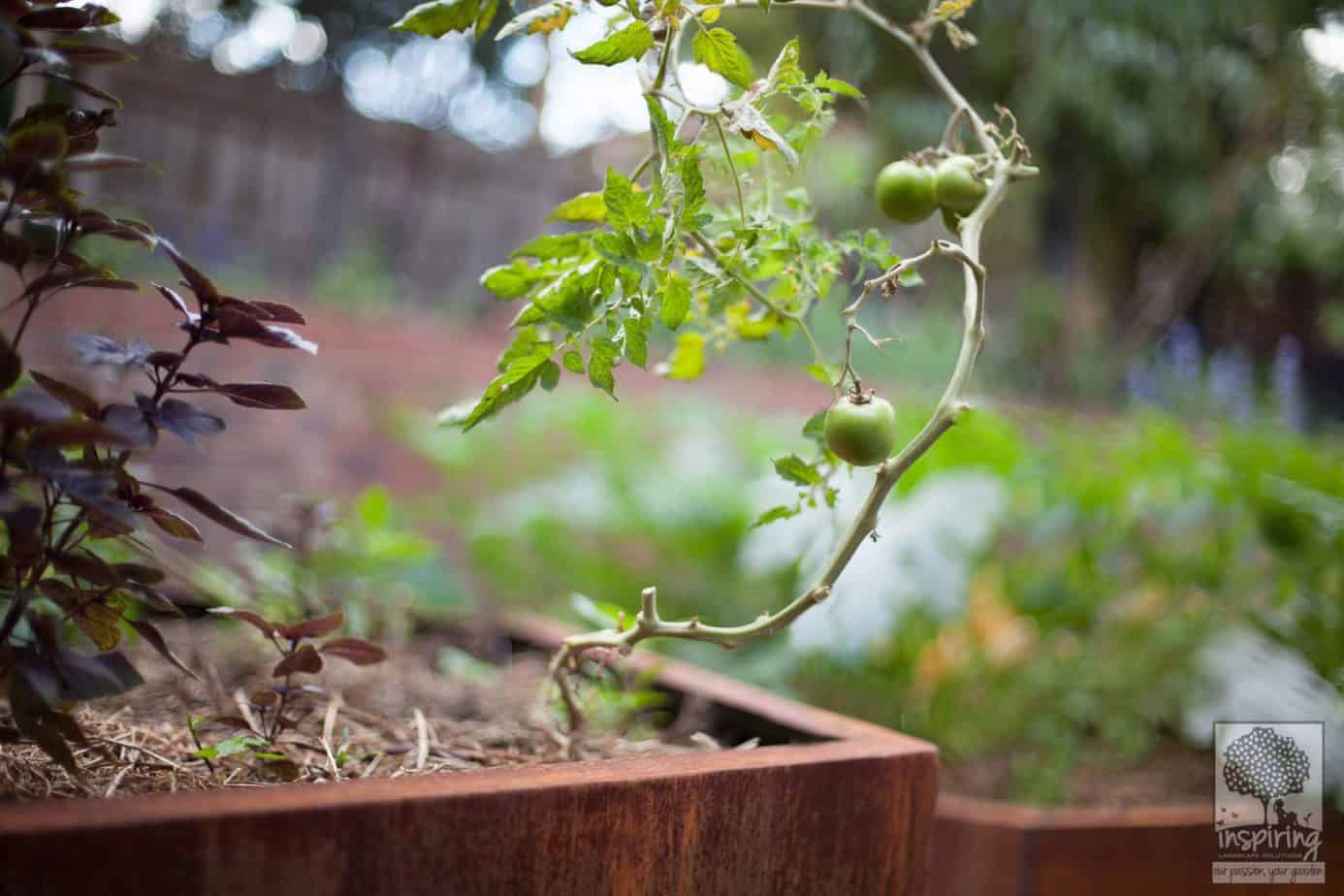
Tomato

Tomatoes are relatively easy to grow.

Start them in September indoors and transplant them in October or November once there is no sign of frost. Provide them with 6 to 8 hours of sunlight daily.

They need pruning and feeding and remember not to water the leaves as they are easily susceptible to fungal diseases.

Tomatoes for your productive garden landscape design

Also, the other insight I’ll share is not to plant them in the same spot every year and not in the same spot as where you’ve planted potatoes (they are from the same family).  Best to rotate them about due to their abovementioned susceptibility to fungal diseases.

Other Inspiration

Hungry for more information on spring planting?

Then check out the following articles!

Spring Vegetable Planting Guide

Vegetable & Herb planting Guide

What to plant each month

Companion planting

In the meantime, do visit my past productive garden projects!

Glen Waverley
Image Not Found On Media Library

Kew

Image Not Found On Media Library

Bundoora

Image Not Found On Media Library

Vermont South A

Image Not Found On Media Library

Blackburn

Image Not Found On Media Library

If you need further garden advice on plant health, garden maintenance or design tips for both indoors and outdoors, please contact us for an onsite 90 minute consultation. 

Refer to our packages for further detail on how we can help you in the consults and subsequently throughout your garden implementation process.

Our passion your garden! xx

Follow us on social media
  • Facebook
  • Instagram
  • Houzz
Email
PREVIOUS POST
Aphids – a friend or a foe?
NEXT POST
Jasmines – which one is right for you?

Parveen

Recent Posts
  • What Summer Reveals About Your Garden (And How to Fix It)
  • Simple Garden Tips to Set Your Garden Up for 2026
  • Prediction – Landscape Garden Trends For 2026 in Australia
  • How to Create a Slow Living Garden
  • When Landscape Designers and Architects Join Forces, Gardens Come Alive
Instagram

inspiringlandscapes.com.au

🌞Summer is the season your garden tells the tru 🌞Summer is the season your garden tells the truth🌞⁠
⁠
When the heat settles in, gardens stop being polite. Plants either thrive or struggle, shady spots become prized real estate, and suddenly you realise which areas you actually use, and which ones you quietly avoid.⁠
⁠
Summer reveals a lot. It shows you where shade is missing, where water is being wasted, and which plants are doing all the hard work without complaint. ⁠
⁠
It also highlights design decisions that looked fine in winter but don’t quite stack up when temperatures rise.⁠
⁠
And here’s the good part: none of this is bad news. It’s insight. Once you understand what summer is showing you, fixing these issues becomes far more intentional and far less overwhelming. ⁠
⁠
Often, small adjustments now can completely change how your garden feels next year.⁠
⁠
We’ve unpacked all of this in our latest blog: What Summer Reveals About Your Garden (And How to Fix It) 🌿⁠
⁠
👉 Read the blog and start using summer as your garden’s greatest teacher: https://inspiringlandscapes.com.au/what-summer-reveals-about-your-garden-and-how-to-fix-it/ ☀️🌱⁠
Forest Hill, 2025 design approved by the City of W Forest Hill, 2025 design approved by the City of Whitehorse! 🥅⚽️🌳⁠
⁠
Love it when the work year begins with so many positives & invigorates me to pump out some more exciting designs this coming year!!!⁠
⁠
This one was a challenging engagement purely from a stakeholder management perspective!!!⁠ On top of the usual stream of documentation for any of my designs, this involved much more paperwork as the process unfolded, to convey the design aesthetic, vision, and strategies to other stakeholders (council, neighbours, and local wildlife groups). ⁠
⁠
The clients and I were very proactive and engaged with the City planners, and finally got this approved with no objections from the neighbourhood wildlife groups or neighbours! 🌟⁠
⁠
Bonus: the client’s nature strip planting was approved, too! 🤩 They can have a “larger” front garden to enjoy whilst sharing it with local birdlife and supporting wildlife habitat too!⁠ Love it when it’s a win-win and everyone is happy with the outcome!!⁠
⁠
I must say it has also been a pleasure working with Gokul and Danielle on this design. They were fully engaged, provided detailed feedback, and remained collaborative throughout. It was fun, and the creativity just flowed! ⁠
⁠
I’m really looking forward to the final phase now, in the next couple of months, bringing it to life and tweaking the design further with their landscaping team to create the outdoor space they will enjoy and love! ⁠
⁠
Below is a very thoughtful review from Gokul:⁠
⁠
“I engaged Parveen to design our landscape and help navigate the complex council requirements  Her attention to detail and knowledge of the process have been outstanding  She’s been incredibly supportive throughout, and I’m excited to see her vision come to life  Highly recommend!⁠”⁠
⁠
#ourpassionyourgarden #inspiringlandscapesolutions #clientreview #testimonials #foresthill⁠
⁠
📸 Pic 1: Forest Hill design: Rear garden 2025⁠
📸 Pic 1: Forest Hill design: Front garden 2025⁠
📸 Pic 3: Forest Hill design: Additional documentation required for council approval purposes, page 1 of 8!⁠
Nothing shouts a garden mural more than a mural of Nothing shouts a garden mural more than a mural of stunning Australian flowers and birds. Obviously, this may be a tad too big for your garden wall, but can you imagine how gorgeous a smaller version of this would look?⁠
⁠
You would be the talk of your neighbourhood. If you were to design an Australian mural for your garden, what would it include? Let us know in the comments below.⁠
⁠
📸 Mooroolbark, Victoria
🌿✨ “A garden is where the soul finds solace 🌿✨ “A garden is where the soul finds solace, and the heart finds peace.”⁠
⁠
There’s a reason this feels so true the moment you step outside. A garden asks nothing of us except to slow down. To breathe. To notice the quiet rhythm of growth happening whether we rush or not.⁠
⁠
In the garden, worries soften. Hands in the soil steady the mind. Watching a plant grow, leaf by leaf, season by season, reminds us that not everything needs to happen all at once. Some things unfold in their own time.⁠
⁠
Whether it’s a sprawling backyard or a small corner filled with pots, gardens become places of refuge. They hold our pauses, our reflections, and our moments of calm. And in a world that’s often loud and fast, that kind of peace is something truly special.⁠
⁠
🌱 May your garden always be a place where you feel grounded, restored, and at home.⁠
💚Natives. 💚⁠ ⁠ Late post!!!😆 On Aust 💚Natives. 💚⁠
⁠
Late post!!!😆

On Australia Day, our gardens quietly reflect the beauty and resilience of this country. From the soft silvery foliage of eucalypts to the vibrant blooms of grevilleas, banksias, and kangaroo paws, our native plants tell a story shaped by sun, wind, and time.⁠
⁠
These plants don’t just look good; they belong here. They thrive in our climate, support local birds and pollinators, and remind us of the deep connection between land and life. ⁠
⁠
A garden filled with natives hums with activity: honeyeaters darting between flowers, bees working tirelessly, leaves moving gently in the summer breeze.⁠
⁠
Australia Day is a moment to step outside, feel the warmth of the day, and appreciate the natural beauty growing right at our feet. ⁠
⁠
Whether it’s a backyard BBQ under a gum tree, a native wildflower in bloom, or a quiet pause in the shade, our gardens offer a space to reflect, connect, and celebrate.⁠
⁠
🌱 Here’s to Australia; its landscapes, its flora, and the gardens that bring a little piece of it home.⁠ 💚⁠
🎨 Nature’s artwork. 🎨⁠ ⁠ A flower is n 🎨 Nature’s artwork. 🎨⁠
⁠
A flower is nature’s artwork, and the more colours it carries, the more breathtaking the masterpiece. 🌸⁠
⁠
When you really pause to look at a flower with layers of colour, it’s impossible not to see it as a piece of art. The way one hue gently fades into another, the contrast between the centre and the petals, the fine lines and patterns that look almost hand-painted; it’s design at its most effortless and extraordinary.⁠
⁠
No two blooms are ever the same. Each one is a unique creation, shaped by light, soil, weather, and time. And just like art, a multi-coloured flower invites you to slow down, look closer, and notice the details you might otherwise rush past.⁠
⁠
In the garden, these flowers do more than add colour. They bring depth, movement, and emotion. They remind us that beauty doesn’t have to be uniform; sometimes it’s the blending, the variation, and the contrast that make something truly special.⁠
⁠
Next time you spot a flower bursting with colour, treat it like a gallery moment. Pause. Observe. Appreciate. Nature has been quietly creating masterpieces all along. 🌿✨⁠
⁠
📸2021 Murrumbeena project⁠ detail
⁠
@paul.osta.photography⁠
🌱🥕 Growing food at home isn’t just a trend 🌱🥕 Growing food at home isn’t just a trend; it’s a mindset shift.⁠
⁠
More people are turning to veggie patches, herb pots, and fruit trees to slow down, reconnect with the seasons, and feel more involved in what they eat. Even the smallest harvest brings a sense of pride and purpose.⁠
⁠
For families, it’s a chance to show kids where food really comes from. For adults, it’s grounding, rewarding, and surprisingly therapeutic. Beyond the personal benefits, growing food supports sustainability and better uses our garden spaces.⁠
⁠
🌿 Whether it’s a full veggie patch or a few pots on a balcony, growing food is about connection: to nature, to nourishment, and to ourselves.⁠
⁠
📸 Pic 1 2022 Kew Project: Rear garden vegetable patch and edible planting⁠
📸 Pic 2 2022 Bundoora project: Citrus espaliers
📸 Pic 3 2022 Bundoora project: Mini vegetable patch⁠
📸 Pic 4 2018 Camberwell project: Cumquat hedge⁠
📸 Pic 5 2012 Vermont South A project detail: Lemonade fruit⁠
📸 Pic 6 2016 Blackburn project: Mini orchard⁠
📸 Pic 7 2016 Blackburn project: Edible planting⁠
📸 Pic 8 2019 Mount Barker, SA project: Mini orchard⁠
📸 Pic 9 2022 Bundoora Project: Vegetables in pots
📸 Pic 10 2022 Glen Waverley: Vegetable patch⁠
🌱✨ Want a better garden in 2026 without worki 🌱✨ Want a better garden in 2026 without working harder?⁠
⁠
The secret isn’t doing more; it’s doing the right things now. Late summer is the perfect time to pause, observe, and make small, intentional changes that set your garden up for long-term success.⁠
⁠
From improving soil health and choosing low-maintenance plants to rethinking how you actually use your outdoor space, a few simple garden tips can make a world of difference. The kind that leads to healthier plants, less maintenance, and a garden that feels calmer and easier to enjoy.⁠
⁠
We’ve broken it all down in our latest blog: Simple Garden Tips to Set Your Garden Up for 2026 🌿⁠
⁠
👉 Read the blog and give your future garden (and future you) a head start:⁠
https://inspiringlandscapes.com.au/simple-garden-tips-to-set-your-garden-up-for-2026/ 🌱⁠
🍷 Your outdoor entertaining area should always 🍷 Your outdoor entertaining area should always feel ready for a “why not?” moment. 🍷⁠
⁠
You know the ones: unexpected guests, last-minute BBQs, warm nights that turn into long conversations. A great entertaining space isn’t just well-designed, it’s well-maintained, too.⁠
⁠
A few thoughtful habits keep it feeling effortless:⁠
⁠
✨ Wipe down benches and tables regularly so they’re always guest-ready⁠
🌿 Keep plants lightly trimmed so the space feels open, not overgrown⁠
💡 Check lighting: good lighting sets the mood and keeps things safe⁠
🪑 Give outdoor furniture some love (covers, quick cleans, shade when possible)⁠
🧹 Clear leaves and debris before they become a bigger job⁠
⁠
When your outdoor area is easy to care for, it’s easier to use.⁠
Less prep. Less stress. More time enjoying good food, fresh air, and great company.⁠
⁠
What makes an outdoor entertaining space feel inviting to you? 🍕⁠
⁠
📸2022 Narre Warren Project rear garden & alfresco⁠
⁠
@paul.osta.photography⁠
Gardening asks us to believe in something we can’t see yet, a tiny seed, holding the promise of colour, growth, and life. And every time we plant one, we’re quietly trusting that magic still exists.⁠
⁠
That childlike belief shows up when we check the soil each morning, when we celebrate the first green shoot, and when we imagine what might bloom weeks or months from now. ⁠
⁠
Gardening keeps wonder alive. It reminds us to be patient, hopeful, and open to small miracles.⁠
⁠
Maybe that’s why time in the garden feels so grounding; it reconnects us with curiosity, optimism, and the simple joy of watching something grow.⁠
⁠
👉 What’s a plant you’re currently waiting (and hoping!) to see sprout? 🌿⁠
💬 “What am I actually paying for?”⁠ ⁠
⁠
Ever received a landscaping quote and thought about that?⁠
⁠
Getting better landscaping quotes isn’t about chasing the cheapest number; it’s about clarity, confidence, and value. A good quote should tell a story, not leave you guessing.⁠
⁠
The best landscaping quotes clearly outline what’s included, what’s not, timelines, materials, and allowances, so there are no surprises down the track. They’re based on honest conversations, site visits, and an understanding of how you actually want to use your outdoor space, not generic assumptions.⁠
⁠
When you know what questions to ask and what to look for, comparing quotes becomes easier and smarter. Suddenly, you’re not just comparing prices, you’re comparing experience, transparency, and long-term outcomes.⁠
⁠
👉 Our latest blog breaks down exactly how to get better landscaping quotes (and avoid costly mistakes along the way). If you’re planning a garden or outdoor project, this one’s a must-read:⁠
⁠
https://inspiringlandscapes.com.au/landscape-quote-process/⁠
⁠
📸 2016 Glen Waverley project detail⁠
White roses have a way of speaking softly, yet lea White roses have a way of speaking softly, yet leaving a lasting impression. They don’t demand attention with bold colour or dramatic flair; instead, they draw you in with their calm presence and timeless beauty.⁠
⁠
Often associated with purity, new beginnings, remembrance, and peace, white roses carry a depth that goes far beyond aesthetics. ⁠
⁠
In the garden, they create moments of pause. They soften spaces, brighten shaded corners, and bring a sense of balance wherever they’re planted.⁠
⁠
What makes white roses especially powerful is how they interact with their surroundings. Against deep green foliage, they glow. Paired with natural stone or timber, they feel elegant and grounding. ⁠
⁠
In the early morning light or at dusk, they almost seem to float; quiet, reflective, and effortlessly beautiful.⁠
⁠
White roses also remind us that not everything needs to be loud to be impactful. Sometimes, restraint is what makes something truly special. They invite us to slow down, notice the details, and appreciate simplicity at its finest.⁠
⁠
Whether planted as a feature or woven gently through a garden, white roses bring a sense of grace that never dates; a reminder that beauty can be both subtle and profound.⁠
⁠
📸2021 Murrumbeena project detail⁠
🍋🌿A thriving lemon tree? Yes please!⁠ ⁠ 🍋🌿A thriving lemon tree? Yes please!⁠
⁠
Good news, it’s easier than you think! A few simple habits make all the difference:⁠
⁠
☀️ Plenty of sunshine (they love the heat)⁠
💧 Deep watering, not too often⁠
🌱 Regular citrus feed during the growing season⁠
✂️ Light pruning for airflow⁠
🌿 Mulch to keep roots cool (keep it off the trunk)⁠
⁠
Do this, and your lemon tree will reward you with glossy leaves, fragrant flowers, and fruit you’ll actually use.⁠
⁠
👉 Lemon tree already growing, or still on the wish list?⁠
⁠
📸 2025 Ardeer project detail⁠
Designing a garden isn’t just about selecting pl Designing a garden isn’t just about selecting plants or creating a beautiful layout; it’s about people. It’s about listening closely, understanding what matters most, and allowing space for ideas to evolve naturally. ⁠
⁠
We truly believe the best results come when clients feel heard, respected, and supported throughout the entire journey.⁠
⁠
Yvette and Lukas are my clients from my Burwood project:⁠
⁠
“Parveen is creative, accommodating, and so easy to work with. She went well and truly above and beyond and gave us the time we needed to get our result.”⁠
⁠
“It was so nice to work with such a lovely and respectful person, and I cannot wait to see our garden come to life.”⁠
⁠
Hearing this means everything to us. Gardens are deeply personal spaces, and being trusted to help shape them is something we never take lightly. We love taking the time to collaborate, refine, and ensure the final design feels right; not rushed, not forced, but thoughtfully considered.⁠
⁠
We’re so grateful for this kind feedback and cannot wait to see this garden grow into a space full of life, beauty, and meaning.⁠
⁠
👉 If you’re dreaming of a garden that feels considered, calm, and truly yours, we’d love to be part of your journey. For more details on my Burwood design, head to https://inspiringlandscapes.com.au/portfolios/burwood/⁠
🗿🌿 Garden Statues: The Secret Spice Your Gar 🗿🌿 Garden Statues: The Secret Spice Your Garden Didn’t Know It Needed!⁠
⁠
Ever wandered through a garden and spotted a statue hiding between the plants, and instantly felt like you’d stepped into a storybook? Yep, that’s the magic of garden statues. ✨⁠
⁠
They’re fun, unexpected, and the perfect way to add personality to your garden beds. Whether it’s a magical creature, a classic sculpture, a meditating figure, or something quirky that makes you smile every time you see it, statues bring a whole new layer of charm.⁠
⁠
Garden statues can:⁠
⁠
🌼 Create focal points⁠
🌱 Add height and structure⁠
👀 Draw the eye through different garden zones⁠
✨ Turn an ordinary bed into a conversation starter⁠
🌿 Bring a little mystery and playfulness to your outdoor space⁠
⁠
And the best part? You get to choose something that reflects you. Your style. Your humour. Your vibe.⁠
⁠
So go on; tuck a little character into your greenery and watch your garden transform from beautiful to unforgettable.⁠
⁠
👉 Do you have a garden statue? What’s your favourite type?⁠
⁠
📸 2018 Hawthorn project detail⁠
✨ “Garden as though you will live forever.”⁠ 🌿⁠
⁠
What a beautiful way to think about gardening. Not rushed. Not perfect. Just intentional, hopeful, and full of belief in what’s to come.⁠
⁠
To garden as though you’ll live forever is to plant trees whose shade you’ll enjoy for years, to nurture soil knowing it only gets better with time, and to choose plants not just for now, but for seasons ahead. It’s about patience, optimism, and trust in growth.⁠
⁠
Gardening teaches us that good things take time. That showing up regularly matters more than doing everything at once. And that tending to something living, something that grows long after the day you plant it, is an act of quiet faith in the future.⁠
⁠
So plant boldly. Care gently. And build a garden that keeps giving, year after year. 🌱⁠
⁠
👉 What’s one plant in your garden you planted for the future?⁠ 💚⁠
⁠
If happiness had a flower, it would definitely be If happiness had a flower, it would definitely be an Argyranthemum. 😍⁠
⁠
Bright, daisy-like blooms. Soft, silvery-green foliage. And that effortless, cheerful vibe that instantly lifts a garden (and your mood).⁠
⁠
These beauties are absolute overachievers:⁠
🌼 Flowering for months on end⁠
☀️ Loving full sun⁠
🌿 Easy to grow and low-fuss⁠
🪴 Perfect in pots and garden beds⁠
🐝 A magnet for bees and pollinators⁠
⁠
Argyranthemums are the kind of plant that make a space feel alive — tucked along a pathway, spilling from a pot, or mixed through a garden bed for that relaxed, cottage-meets-coastal look. They don’t demand attention … but they always get it.⁠
⁠
If your garden needs a little extra joy, colour, and feel-good energy, this might be your sign to plant some. 🌼⁠
⁠
👉 Are Argyranthemums already in your garden, or are they going straight on the wish list?⁠ 🤩💚⁠
As we say goodbye to another year, we’re feeling As we say goodbye to another year, we’re feeling incredibly grateful for beautiful gardens, amazing clients, creative projects, and every little moment spent outdoors. 🎇⁠
⁠
Here’s to the memories made in our gardens, the growth we’ve seen (in plants and in ourselves!), and the fresh possibilities waiting for us in the year ahead.⁠
⁠
Whether you’re celebrating with friends and family or enjoying a quiet night under the stars, we hope your evening is filled with joy, reflection, and a touch of magic. ✨⁠
⁠
🎆 Cheers to a bright, blooming, and inspiring New Year!⁠
We can’t wait to create even more beautiful spaces with you in the year to come.⁠
Who says garden design is only about plants and pa Who says garden design is only about plants and pathways? Sometimes, the most unexpected showstopper is a mural tucked into your outdoor space. And wow, can it transform a garden!⁠
⁠
It’s one of the quickest, boldest ways to transform a plain space into something unforgettable.⁠
⁠
A mural can:⁠
🎨 Add personality and colour⁠
🎨 Create a stunning focal point⁠
🎨 Bring depth to small spaces⁠
🎨 Make your garden feel intentional and artistic⁠
⁠
Whether it’s botanical, abstract, geometric, or deeply personal, a mural turns a blank wall into a story — one that grows more beautiful as the garden surrounds it.⁠
⁠
Would you add a mural to your outdoor space? What style would you choose?⁠
⁠
📸:⁠ Mural by Wongi ‘Freak’ Wilson, New Regent Street, Christchurch, New Zealand. Depicting a stunning woman in a glamourous dress, highlighting the eventful and theatrical history of the area which was established in 1932⁠
Snap from my gorgeous client in Berwick⁠ ⁠ Cre Snap from my gorgeous client in Berwick⁠
⁠
Cream clivia’s - looks so delish that you can eat them!!⁠
⁠
Hope that everyone’s having an awesome Xmas break!!! 🥳🥳🥳💚💚💚🍷🍷🍷🎄🎄🎄
Follow on Instagram
Archives
  • February 2026
  • January 2026
  • December 2025
  • November 2025
  • October 2025
  • August 2025
  • July 2025
  • June 2025
  • May 2025
  • April 2025
  • March 2025
  • January 2025
  • November 2024
  • October 2024
  • September 2024
  • July 2024
  • June 2024
  • May 2024
  • April 2024
  • February 2024
  • January 2024
  • December 2023
  • November 2023
  • September 2023
  • August 2023
  • July 2023
  • June 2023
  • May 2023
  • April 2023
  • March 2023
  • December 2022
  • November 2022
  • October 2022
  • July 2022
  • June 2022
  • April 2022
  • March 2022
  • January 2022
  • December 2021
  • September 2021
  • August 2021
  • July 2021
  • May 2021
  • April 2021
  • March 2021
  • February 2021
  • January 2021
  • December 2020
  • November 2020
  • October 2020
  • September 2020
  • August 2020
  • July 2020
  • June 2020
  • May 2020
  • April 2020
  • March 2020
  • February 2020
  • January 2020
  • December 2019
  • November 2019
  • October 2019
  • September 2019
  • August 2019
  • July 2019
  • June 2019
  • May 2019
  • April 2019
  • March 2019
  • February 2019
  • January 2019
  • December 2018
  • November 2018
  • October 2018
  • September 2018
  • August 2018
  • July 2018
  • June 2018
  • May 2018
  • April 2018
  • March 2018
  • February 2018
  • January 2018
  • December 2017
  • November 2017
  • October 2017
  • September 2017
  • August 2017
  • July 2017
  • June 2017
  • May 2017
  • April 2017
  • March 2017
Categories
  • Animals
  • Arbour
  • Architects
  • Art
  • Australian Natives
  • Balcony Gardens
  • Biophilia
  • Birds
  • Blog
  • Budgeting
  • Children
  • Colour
  • Colour and Scent
  • Construction
  • Decking
  • Design
  • Edibles
  • Feng Shui
  • Flower and Garden Shows
  • Flowers
  • Garden
  • Garden and Landscaping Trends
  • Garden Design
  • Gardening For Beginners
  • Gardens for Life
  • Health
  • Home
  • Home office
  • Irrigation
  • Landscape Design
  • Landscaping
  • Lawn
  • Maintenance
  • Materials
  • Nature
  • Outdoor Entertaining
  • Paving
  • Plant collectors
  • Plants
  • Productive gardening
  • Productive gardens
  • Propagation
  • Pruning
  • Scented gardens
  • Seasonal tips
  • Site surveys
  • Soil pH
  • Staging for sale
  • Structures
  • Sustainable Gardening
  • Uncategorized
  • Water Features
  • Weather
  • Wildlife

Related News

Other posts that you should not miss
Long-shot view of a chartreuse Cercis Canadensis tree surrounded by jasmine in the Brunswick East rear garden design

What Summer Reveals About Your Garden (And How to Fix It)

February 3, 2026
-
Posted by Parveen
Summer has a funny way of telling the truth. When the heat lingers, the sun is relentless, and outdoor spaces are used…
Read More →
Australian Natives, Decking, Design, Edibles, Flowers, Garden, Garden Design, Gardening For Beginners, Gardens for Life, Irrigation, Landscape Design, Landscaping, Lawn, Maintenance, Outdoor Entertaining, Plants, Seasonal tips, Uncategorized, Weather
7 MIN READ
Memorial Drive NW

Simple Garden Tips to Set Your Garden Up for 2026

January 2, 2026
-
Posted by Parveen
The beginning of a new year often brings a quiet moment of reflection, and for many of us, that reflection naturally extends…
Read More →
Design, Garden, Garden Design, Gardens for Life, Irrigation, Landscape Design, Maintenance, Materials, Plants, Sustainable Gardening, Uncategorized
8 MIN READ
Use a table top fountain to make your own water oasis

Prediction – Landscape Garden Trends For 2026 in Australia

December 6, 2025
-
Posted by Parveen
Every year introduces a fresh wave of inspiration to garden design, but 2026 is shaping up to be one of the most…
Read More →
Design, Edibles, Flowers, Garden and Landscaping Trends, Garden Design, Landscape Design, Landscaping, Materials
9 MIN READ

Follow us on social media

  • Facebook
  • Instagram
  • Houzz

ACN: 617 529 914

contact +614 0332 9128

contact@inspiringlandscapes.com.au

 
What to Plant in Spring, a Planting Guide - Inspiring Landscape Solutions