When people begin planning a new garden, one of the first questions they ask is, “What plants should we use to create a sustainable and vibrant space?” As a Melbourne landscape designer, I rarely start there.
Instead, I ask a different question:
“How do you want to feel when you walk through your garden ten years from now?”
That question changes everything.
The most memorable gardens are never simply collections of beautiful plants. They’re living communities that evolve, surprise, delight and reconnect us with nature every single day. They become places where children chase butterflies, birdsong replaces traffic noise, every season reveals something new, and simply sitting outside after a long day becomes restorative.
To me, this is where truly great landscape design begins.
A professionally designed garden should do far more than enhance street appeal. It should enrich your daily life, foster emotional wellbeing, deepen your connection to nature, support local biodiversity, adapt to our changing climate, and continue becoming more beautiful as it matures.
That’s the philosophy behind every landscape I design. I don’t simply select plants or create attractive planting schemes; I compose living plant communities that enrich people’s lives while giving nature a place to thrive.

More than beautiful plants creating living ecological systems
At its core, biodiverse planting design creates plant communities that function like living ecosystems rather than static decorative displays.
Instead of relying on isolated feature plants or repetitive mass planting, a carefully considered planting palette combines trees, shrubs, perennials, ornamental grasses, climbers, and groundcovers into layered communities that work together.
For Melbourne gardens, this might mean pairing an evergreen structure from Elaeocarpus Reticulatus with the seasonal colour of Salvia Bodacious® ‘Smokey Jazz’, the architectural foliage
of Patersonia Occidentalis, and long-flowering perennials like Scabiosa ‘Blue Lace’, demonstrating how diverse plantings support ecological health.
Each species contributes something unique, but together they create a planting community that is far richer than any individual plant could achieve. While this is just one example, I carefully tailor every planting palette to the site, architecture, lifestyle, and environmental conditions of each project.
Nature has been refining this approach for millions of years.
Walk through a woodland, coastal dune or native grassland, and you’ll quickly notice that no plant exists in isolation. Every species plays a role, and those roles overlap in complex and interdependent ways.
Some plants stabilise soil. Others attract pollinators. Some provide shelter for wildlife, while others flower at precisely the right moment to feed beneficial insects. Beneath the surface, intricate root systems interact with fungi and microorganisms, continually improving soil health and nutrient cycling.
None of this happens by chance.
Likewise, successful garden design isn’t simply about choosing attractive plants. It’s about carefully composing relationships that allow an entire landscape to function as one interconnected living system.
That is where the real artistry of planting design lies.
Why complexity creates stronger gardens
In traditional garden design, simplicity is often associated with elegance.
Yet in biodiverse planting design, complexity fosters resilience, beauty, and a sense of wonder that lasts over time.
I often compare it to an orchestra.
A single violin can produce beautiful music.
An entire orchestra creates emotion.
Strings, brass, percussion and woodwind each contribute

something unique, yet together they produce a richness that no single instrument could ever achieve alone.
Planting design works in the same way.
Each plant layer contributes something different while simultaneously supporting every other layer.
Together they create:
*Longer and overlapping flowering seasons
*Richer textures and seasonal interest
*Greater resilience to pests and disease
*Improved soil structure through varied root systems
*Valuable habitat for birds, butterflies and pollinators
*Increased tolerance to Melbourne’s changing climate
*Cooler outdoor spaces through layered shade and evapotranspiration
Greater ecological stability over time.
Groundcovers help retain soil moisture.
Perennials provide seasonal colour.
Shrubs create shelter and microclimates.
Trees regulate temperature, filter light and establish the structural framework of the garden.
The result is far greater than the sum of its individual parts.
One of my favourite planting combinations is to layer deciduous canopy trees over evergreen shrubs, weaving ornamental grasses and flowering perennials through the understorey. In spring, flowering bulbs emerge beneath fresh foliage. Summer brings movement and pollinator activity. Autumn introduces spectacular foliage colour, while winter reveals bark texture, evergreen structure and seed heads that continue supporting birds and beneficial insects. Each layer has a purpose, keeping the garden engaging year-round rather than peaking for only a few weeks.

Art is creating complexity without creating maintenance
One of the biggest misconceptions surrounding biodiverse gardens is that more plants automatically mean more work.
In reality, careful landscape planting does exactly the opposite, empowering you to create gardens that thrive with less effort.
The goal isn’t simply to add more species.
The goal is to design plant communities that naturally support one another.
When plants occupy appropriate ecological niches, they
suppress weeds, shade the soil, reduce evaporation, encourage beneficial insects, and build healthier soils.
Over time, the landscape begins regulating itself rather than relying on constant human intervention.
The art isn’t creating complexity.
The art is creating the illusion of effortless abundance while designing a landscape that becomes easier to maintain as it matures. I consider balancing biodiversity with practical maintenance on every project.
While I love creating richly layered planting, I also understand that gardens need to work for busy families. Every planting decision considers future maintenance, longevity, seasonal performance, and how each plant contributes to the broader living system.
That balance is what transforms a beautiful garden into one that remains enjoyable for decades.
For example, I may repeat dependable structural plants throughout a garden while introducing smaller groups of seasonal performers that provide changing colour and texture. This creates the richness people associate with natural landscapes without requiring dozens of high-maintenance species.
Carefully selecting hardy plants suited to Melbourne’s climate also reduces irrigation, pruning and replacement over time, proving that biodiversity and low maintenance are not mutually exclusive when planting is thoughtfully designed.
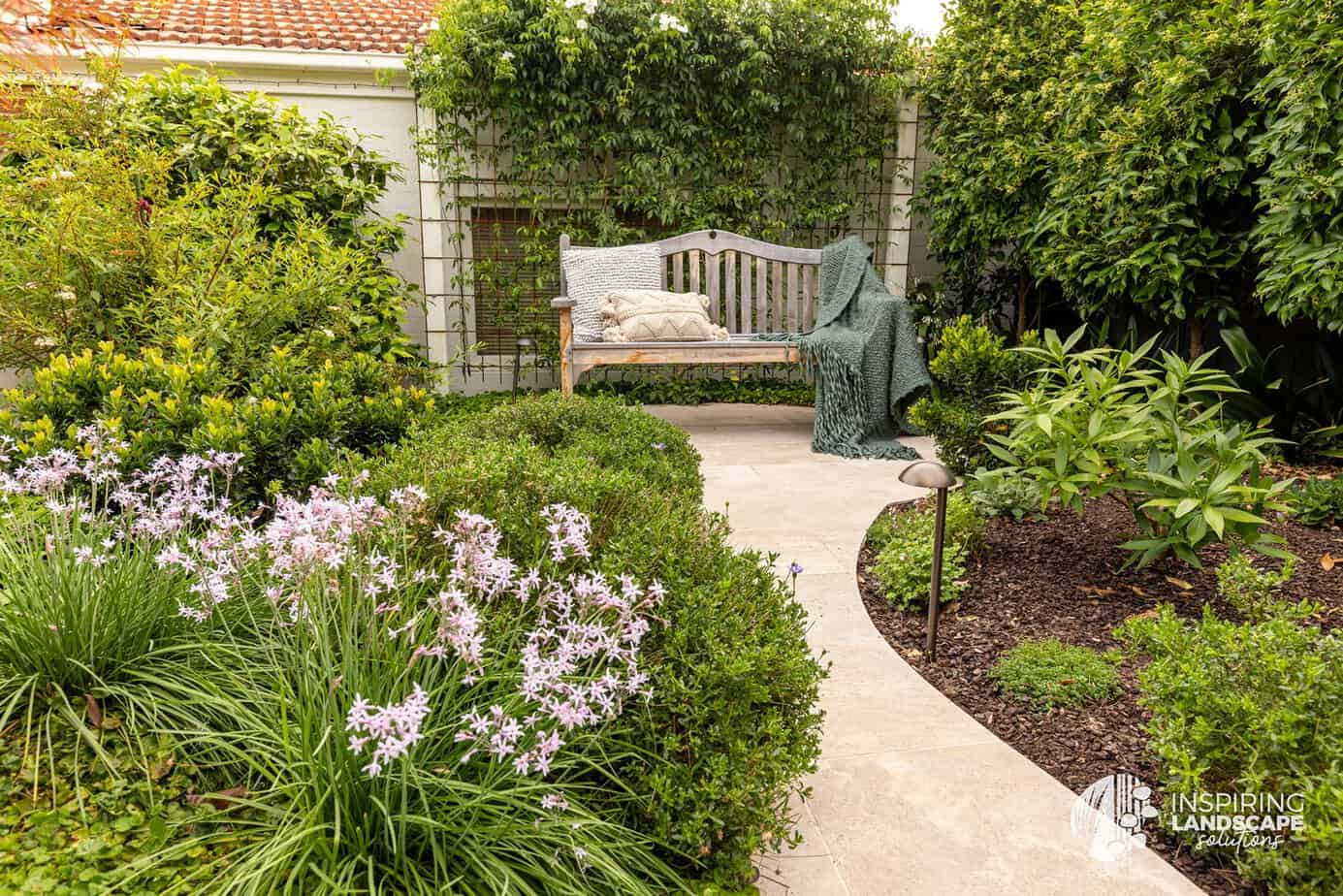
One recent Melbourne landscape design project perfectly demonstrates this philosophy. Rather than filling every available space with plants, the design focused on creating carefully layered planting communities that balanced evergreen structure, flowering perennials, ornamental grasses and seasonal interest.
Every plant was selected because it contributed something meaningful to the overall ecosystem. Whether that was supporting pollinators, providing habitat, creating movement, framing views or reducing long-term maintenance. The result is a garden that feels lush and immersive without feeling cluttered, becoming richer and more beautiful as the planting matures year after year.
Why nature makes us feel better
Humans have an innate desire to connect with nature.
This principle sits at the heart of biophilic landscape design, which recognises that our physical and emotional wellbeing improves when we experience natural environments.
Biodiverse planting design naturally encourages this connection because it engages all our senses.
Instead of delivering a fixed visual composition, these gardens constantly evolve.
Grasses sway gently in the breeze.
Morning sunlight filters through layered canopies.
Birds move between shrubs.
Butterflies drift from flower to flower.

The fragrance of flowering plants changes throughout the day.
Textures shift with the seasons.
Light, shadow and colour continually transform the landscape.
Rather than simply looking at a garden, you become immersed within it.
Every visit feels slightly different.
Every season reveals something new.
That quiet sense of discovery is precisely what makes these landscapes so restorative.
One recent courtyard project reinforced this perfectly. Although compact, introducing layered planting, seasonal texture, and greater biodiversity completely transformed how the owners experienced the space. What had previously felt like an overlooked area became somewhere they genuinely wanted to spend time; proof that meaningful connections with nature don’t require large gardens, only thoughtful planting design.

Biodiversity as a daily experience
Biodiversity is often discussed in scientific language.
For homeowners, however, its greatest value is something far more personal.
It is experienced.
A biodiverse garden is never truly still.
Even when it appears calm, it is active at multiple scales.
You might notice bees moving between flowering layers, tiny native birds weaving through shrubs, dragonflies hovering over water, or the subtle rustle of ornamental grasses responding to the afternoon breeze.
Even beneath the soil, countless unseen interactions are quietly supporting healthier plants.
These tiny interactions, often described as “micro-moments”, accumulate into something surprisingly powerful. The garden becomes immersive.
Your eyes wander.
Your curiosity grows.
Children discover insects.
Visitors notice details they missed before.
The garden continues telling new stories long after it has been planted.
I’ve always believed that a great garden should never reveal its whole story in the first five minutes. It should reward curiosity and invite people to slow down. A shaft of afternoon light filtering through ornamental grasses, the unexpected appearance of a butterfly, the changing silhouette of a deciduous tree through the seasons, or a flowering perennial that quietly steals the show before gracefully giving way to another.
These seemingly small moments aren’t accidental; they’re carefully composed experiences that make layered planting feel alive and emotionally engaging long after the garden is complete.
For me, that’s one of the greatest joys of landscape design.
I don’t design gardens to impress people the day construction finishes.
I design gardens that become more beautiful five, ten and twenty years later.
Why My Planting Designs Feel Different
Every landscape designer selects plants.
My role goes far beyond choosing species that look attractive together.
I carefully compose living plant communities that balance biodiversity, structure, seasonal succession, texture, colour, wildlife habitat, maintenance requirements and long-term resilience.
Each planting palette is unique because every family lives differently.

Some clients want restorative spaces to unwind after work.
Others want children to connect with nature.
Some seek greater privacy.
Others want productive gardens, bird habitat or year-round visual interest.
Understanding these aspirations allows me to create landscape designs that feel deeply personal while functioning as thriving ecological systems.
Where clients engage me during the construction phase, I continue working alongside them to refine planting layouts on site, source quality plant material, and make thoughtful adjustments as real-world conditions evolve.
As living landscapes are never static, I believe the best results come from remaining involved as the garden begins its journey, ensuring the original design vision is realised with the same care and attention that shaped it from the beginning.
The result is not simply a beautiful garden.
It is a landscape that feels alive.
One that rewards repeat visits because there is always something new to discover.




Leave a Comment